| Solar
Cookers International... 1919 21st Street, #101 Sacramento, CA 95811 USA Tel. 916-455-4499 |
Solar Cooker Review March 2007 |
The Solar Cooking Archive: |
|
E-mail: info
Volume 13, Number 1 |
Paper Circulation: 10,000 |
|
 solarcookers.org

[Editor's note: "News you send" is compiled by Tom Sponheim, Solar Cookers International's information exchange specialist. E-mail your news items to info@solarcookers.org or mail to Ramón Coyle, Solar Cookers International, 1919 21st Street #101, Sacramento, California 95811-6827, USA. We want to hear from you — especially if your program is growing or if your work has not been featured in the Solar Cooker Review before. Please include your contact information. Submissions are subject to editing if printed.]
AFRICA
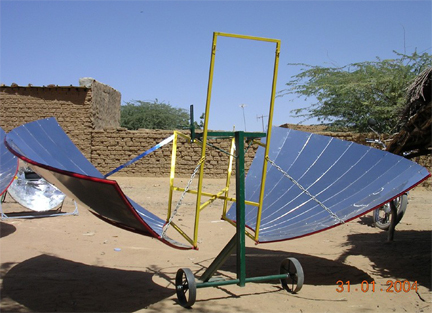 Community members in Bobo Dioulasso formed the
TLE NAFA association in 2004
to promote solar energy and reduce deforestation. In 2005, the association
carried out two projects with 35
Papillon solar cookers: curved
concentrators consisting of two reflective "wings" with a gap in between to
allow for comfortable use by the cook, and folding reflectors for transport
and storage. The cookers were made in Ouagadougou and assembled in Bobo
Dioulasso.
After a 20% subsidy, the cookers sold for about 120 euro each. Sales
proceeds were used to buy additional supplies. TLE NAFA planned to sell at
least 15 more in 2006. The group is currently seeking financial support. Contact:
Monika Hermann-Sanou, Association TLE NAFA, B.P. 3440, Bobo
Dioulasso, Burkina Faso. E-mail:
monikasanou@yahoo.fr
Community members in Bobo Dioulasso formed the
TLE NAFA association in 2004
to promote solar energy and reduce deforestation. In 2005, the association
carried out two projects with 35
Papillon solar cookers: curved
concentrators consisting of two reflective "wings" with a gap in between to
allow for comfortable use by the cook, and folding reflectors for transport
and storage. The cookers were made in Ouagadougou and assembled in Bobo
Dioulasso.
After a 20% subsidy, the cookers sold for about 120 euro each. Sales
proceeds were used to buy additional supplies. TLE NAFA planned to sell at
least 15 more in 2006. The group is currently seeking financial support. Contact:
Monika Hermann-Sanou, Association TLE NAFA, B.P. 3440, Bobo
Dioulasso, Burkina Faso. E-mail:
monikasanou@yahoo.fr
 KoZon Foundation began introducing solar
CooKits in Gorom-Gorom, Oudalan in
1997. As is often the case, initial acceptance was very high. To measure
long-term acceptance and usage, KoZon surveyed more than 50 families
multiple times from 2002-2005.
During the dry season, lasting from March-June, 30-45% of the families used
their CooKits regularly (approximately 3-7 times per week). The month of
April had highest usage, followed by May and March respectively. CooKits
were used to cook a variety of foods, especially rice and sauces of meat,
chicken or legumes. Nearly all families rated food taste as good to very
good. CooKits were also used to heat milk for making yoghurt, and to heat
water for making tea and coffee, as well as for washing purposes. Several
families said that the capacity of one CooKit was not enough for large
families, and that two CooKits would be better. Durability of the cooker was
also mentioned as a concern, given that the cost of a CooKit and a pot is
5000 to 7500 CFA franc, or about $10 to $15. Even though this is quite
expensive for the families of Gorom-Gorom, each solar-cooked meal saved an
estimated 50-180 CFA franc in fuel costs. Over 90% of the families said they
planned to buy a replacement CooKit when theirs wears out.
KoZon lists several lessons learned during this process, including: 1) One
CooKit is best suited for families of less than six members, or for single
male households; 2) Complementary technologies, such as fuel-efficient wood
stoves and heat-retention cookers, should continue to be taught in addition
to solar cookers; and 3) Ongoing guidance, encouragement and follow-up
should be provided by trained members of local institutions. Contact: Wietske Jongbloed, Stichting KoZon, Hollandseweg 384, 6705 BE
Wageningen, Netherlands. Tel: 31-317412370, fax: 31-317410732, e-mail:
wietske-jongbloed@tele2.nl, Web:
www.kozon.org
KoZon Foundation began introducing solar
CooKits in Gorom-Gorom, Oudalan in
1997. As is often the case, initial acceptance was very high. To measure
long-term acceptance and usage, KoZon surveyed more than 50 families
multiple times from 2002-2005.
During the dry season, lasting from March-June, 30-45% of the families used
their CooKits regularly (approximately 3-7 times per week). The month of
April had highest usage, followed by May and March respectively. CooKits
were used to cook a variety of foods, especially rice and sauces of meat,
chicken or legumes. Nearly all families rated food taste as good to very
good. CooKits were also used to heat milk for making yoghurt, and to heat
water for making tea and coffee, as well as for washing purposes. Several
families said that the capacity of one CooKit was not enough for large
families, and that two CooKits would be better. Durability of the cooker was
also mentioned as a concern, given that the cost of a CooKit and a pot is
5000 to 7500 CFA franc, or about $10 to $15. Even though this is quite
expensive for the families of Gorom-Gorom, each solar-cooked meal saved an
estimated 50-180 CFA franc in fuel costs. Over 90% of the families said they
planned to buy a replacement CooKit when theirs wears out.
KoZon lists several lessons learned during this process, including: 1) One
CooKit is best suited for families of less than six members, or for single
male households; 2) Complementary technologies, such as fuel-efficient wood
stoves and heat-retention cookers, should continue to be taught in addition
to solar cookers; and 3) Ongoing guidance, encouragement and follow-up
should be provided by trained members of local institutions. Contact: Wietske Jongbloed, Stichting KoZon, Hollandseweg 384, 6705 BE
Wageningen, Netherlands. Tel: 31-317412370, fax: 31-317410732, e-mail:
wietske-jongbloed@tele2.nl, Web:
www.kozon.org
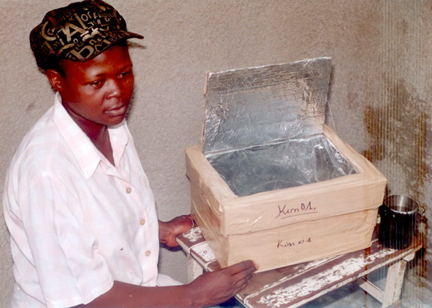 Sylvain Kimour Kalubi of the
Terre de la Paix group has been busy
translating solar cooker information on the
Solar Cooking Archive into several local languages. Kalubi and his
colleagues have also been experimenting with various cooker designs,
including the 12-sided Parvati model, and have developed their own solar box
cooker called the KIN 1.
Kalubi has found advantages to using cassava (or manioc) flour instead of
wheat flour for making
paste. He says the cassava flour is cheaper in the
Congo than wheat flour, and it makes a stronger glue for cardboard solar
cookers. Contact: Sylvain Kimour Kalubi, Terre de la Paix, B.P. 10796, Kinshasa 1,
Democratic Republic of the Congo. E-mail:
kalubi2001@yahoo.fr
Sylvain Kimour Kalubi of the
Terre de la Paix group has been busy
translating solar cooker information on the
Solar Cooking Archive into several local languages. Kalubi and his
colleagues have also been experimenting with various cooker designs,
including the 12-sided Parvati model, and have developed their own solar box
cooker called the KIN 1.
Kalubi has found advantages to using cassava (or manioc) flour instead of
wheat flour for making
paste. He says the cassava flour is cheaper in the
Congo than wheat flour, and it makes a stronger glue for cardboard solar
cookers. Contact: Sylvain Kimour Kalubi, Terre de la Paix, B.P. 10796, Kinshasa 1,
Democratic Republic of the Congo. E-mail:
kalubi2001@yahoo.fr
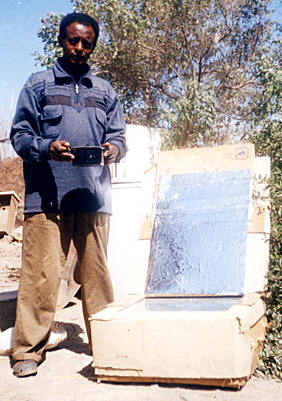 Nahom Nigussie
of Eritrea writes that he made a solar box cooker based on the
instructions sent to him by Solar Cookers International. "I cooked rice,
sauce and shiro (traditional pea sauce) within two hours, and one
hour for tea. I expect it will cook better in shorter time during summer. …
It is fascinating to look at the food cooked by sun. The fascination of
making and using solar cookers also lies in its freely available source of
energy — the sun."
Nahom Nigussie
of Eritrea writes that he made a solar box cooker based on the
instructions sent to him by Solar Cookers International. "I cooked rice,
sauce and shiro (traditional pea sauce) within two hours, and one
hour for tea. I expect it will cook better in shorter time during summer. …
It is fascinating to look at the food cooked by sun. The fascination of
making and using solar cookers also lies in its freely available source of
energy — the sun."
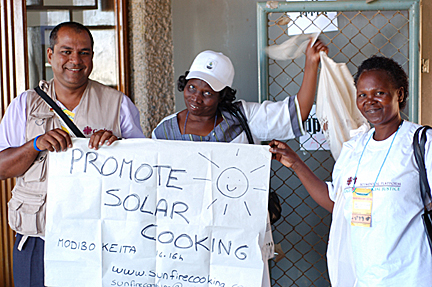 Representatives of
Somalia-based
Sun Fire Cooking attended January's World
Social Forum in Nairobi, where they organized a group of activists to plan a
three-part campaign of education, mobilization and networking for solar
cooking. Sun Fire Cooking plans to open a solar cooking promotion center in Nairobi
with support from
Horn Relief, a nonprofit organization in Somalia.
Meanwhile, Sun Fire Cooking continues its work spreading solar cooking in
Puntland, Somalia, and plans to expand to the Hargeisa area. The
organization also has experience in Djibouti, having sold 25 solar cookers
there. Contact:
Jim Lindsay, Sun Fire Cooking, 10680 Hampshire Ave S., Apt. 105,
Bloomington, Minnesota 55438, USA. E-mail:
sunfirecooking@yahoo.com
Representatives of
Somalia-based
Sun Fire Cooking attended January's World
Social Forum in Nairobi, where they organized a group of activists to plan a
three-part campaign of education, mobilization and networking for solar
cooking. Sun Fire Cooking plans to open a solar cooking promotion center in Nairobi
with support from
Horn Relief, a nonprofit organization in Somalia.
Meanwhile, Sun Fire Cooking continues its work spreading solar cooking in
Puntland, Somalia, and plans to expand to the Hargeisa area. The
organization also has experience in Djibouti, having sold 25 solar cookers
there. Contact:
Jim Lindsay, Sun Fire Cooking, 10680 Hampshire Ave S., Apt. 105,
Bloomington, Minnesota 55438, USA. E-mail:
sunfirecooking@yahoo.com
McDonald Ganisyeje reports that a solar cooker construction workshop has opened in Nkhotakota, with three employees. Solar CooKits cost about $5.40 to produce, using heavy cardboard that is cut by hand. Ganisyeje hopes to open additional workshops in the Chiradzulu District and the Mchinji-Lilongwe area. Contact: McDonald Ganisyeje, Land & Lake Safaris, Box 2140, Lilongwe, Malawi. E-mail: mcdonald@landlake.net
Mozambique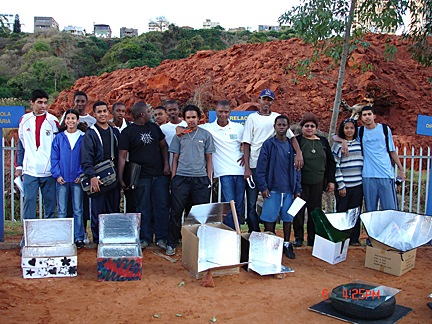 Maria dos Anjos Rosario taught a solar cooking class to 11th and 12th grade
students at the Secondary School of the Superior Institute of Science and
Technology. The class included discussion of how solar cookers work,
construction of several models of solar cookers, solar cooking practice,
analysis of the activities, and discussion of how to spread solar cooking.
Rosario is president of the
Mozambique Association for Urban Development,
which promotes solar cookers, "wonder box"
heat-retention cookers, and paper
briquettes — a firewood and charcoal substitute. Contact: Maria dos Anos Rosario, Avenue Julius Nyerere 562, Maputo,
Mozambique. E-mail: anjos@tvcabo.co.mz
Sudan
Maria dos Anjos Rosario taught a solar cooking class to 11th and 12th grade
students at the Secondary School of the Superior Institute of Science and
Technology. The class included discussion of how solar cookers work,
construction of several models of solar cookers, solar cooking practice,
analysis of the activities, and discussion of how to spread solar cooking.
Rosario is president of the
Mozambique Association for Urban Development,
which promotes solar cookers, "wonder box"
heat-retention cookers, and paper
briquettes — a firewood and charcoal substitute. Contact: Maria dos Anos Rosario, Avenue Julius Nyerere 562, Maputo,
Mozambique. E-mail: anjos@tvcabo.co.mz
Sudan
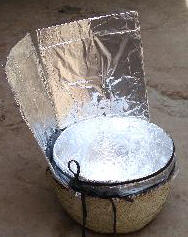 The nonprofit
Darfur Peace and Development Organization (DPADO) is
incorporating solar cooking as part of its project to establish women's
centers for displaced Darfurians in
Sudan. The solar cooking component is
coordinated by
Stephen Harrigan, who has built and experimented with solar
cookers and has demonstrated their use in Darfur. According to Harrigan,
DPADO has "a large local Sudanese infrastructure already in place in Darfur
to really promote this well" in camps for displaced people. He hopes to
begin training in Khartoum this spring. Contact: Stephen Harrigan, Darfur Peace and Development Organization, c/o Suliman Giddo, P.O. Box 5743, Fort Wayne, Indiana 46895, USA. Tel: 1 (260)
418-6699, e-mail: stephensheila_1@msn.com, Web:
www.dpado.org
The nonprofit
Darfur Peace and Development Organization (DPADO) is
incorporating solar cooking as part of its project to establish women's
centers for displaced Darfurians in
Sudan. The solar cooking component is
coordinated by
Stephen Harrigan, who has built and experimented with solar
cookers and has demonstrated their use in Darfur. According to Harrigan,
DPADO has "a large local Sudanese infrastructure already in place in Darfur
to really promote this well" in camps for displaced people. He hopes to
begin training in Khartoum this spring. Contact: Stephen Harrigan, Darfur Peace and Development Organization, c/o Suliman Giddo, P.O. Box 5743, Fort Wayne, Indiana 46895, USA. Tel: 1 (260)
418-6699, e-mail: stephensheila_1@msn.com, Web:
www.dpado.org
 The
Web site of
Solar Circle tells an inspiring story
of how a few people can make a big difference by working together. Solar
Circle is a US-based nonprofit organization made up of a network of friends,
mostly women. A few years ago, Solar Circle took two dozen American-made
Global Sun Ovens® to Masasi,
Tanzania, where they were enthusiastically
received. However, people quickly saw the impossibility of importing enough
ovens to overcome high purchase and transport costs. Consequently, Solar
Circle has started a small industry in Tanzania to build solar box cookers.
Several
The
Web site of
Solar Circle tells an inspiring story
of how a few people can make a big difference by working together. Solar
Circle is a US-based nonprofit organization made up of a network of friends,
mostly women. A few years ago, Solar Circle took two dozen American-made
Global Sun Ovens® to Masasi,
Tanzania, where they were enthusiastically
received. However, people quickly saw the impossibility of importing enough
ovens to overcome high purchase and transport costs. Consequently, Solar
Circle has started a small industry in Tanzania to build solar box cookers.
Several
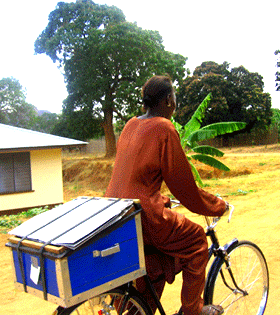 Tanzanian craftspeople have joined in the effort. They make the
outer box from cypress wood, which is treated with cashew nut oil to
repel
insects. Reflective surfaces are made by collecting and cleaning discarded
lithographic plates, and crafting them into the proper shapes. Gaskets are
made from used tires or shoe leather.
Students from the Mechanical Engineering Design Program at Michigan State
University (USA) are collaborating to develop a model that is lighter,
cheaper and more efficient, using only domestic Tanzanian materials and
manufacturing processes. Mlelwa, one Tanzanian who built a solar oven,
coined a new proverb: "People say 'Jua kali,' but we know 'Jua ni
mali .'"
(People say the sun is hot today, but we know the hot sun is wealth). Contact: Solar Circle, 4709 Woodcraft, Okemos, Michigan 48864, USA. E-mail:
info@solar-circle.org, Web:
www.solar-circle.org
Tanzanian craftspeople have joined in the effort. They make the
outer box from cypress wood, which is treated with cashew nut oil to
repel
insects. Reflective surfaces are made by collecting and cleaning discarded
lithographic plates, and crafting them into the proper shapes. Gaskets are
made from used tires or shoe leather.
Students from the Mechanical Engineering Design Program at Michigan State
University (USA) are collaborating to develop a model that is lighter,
cheaper and more efficient, using only domestic Tanzanian materials and
manufacturing processes. Mlelwa, one Tanzanian who built a solar oven,
coined a new proverb: "People say 'Jua kali,' but we know 'Jua ni
mali .'"
(People say the sun is hot today, but we know the hot sun is wealth). Contact: Solar Circle, 4709 Woodcraft, Okemos, Michigan 48864, USA. E-mail:
info@solar-circle.org, Web:
www.solar-circle.org
Dozens of delegates from many parts of Togo and Ghana attended a conference last December in Lome themed "climate change: a socio-political challenge." The conference was organized by Jeunes Volontaires pour l'Environnement (JVE) and showcased solar cooking and solar water pasteurization. Demonstrations and construction workshops were available to conference attendees. Beneficiaries of a JVE solar project shared testimonials of how solar cooking has changed lives in the Vo region. Also attending the conference were Togo's Deputy Director of the Ministry of Environment, the Chief Cabinet to the Minister of Youth, and representatives of the media. Contact: Jeunes Volontaires pour l'Environnement, Box 8823, Lome, Togo. Tel: +228-2200112, e-mail: yvetogo@hotmail.com, Web: www.ong-jve.org
UgandaIn the last six months of 2006, the Solar Connect Association (SCA) distributed 300 solar CooKits in rural areas of western Uganda, including the villages of Kikokwa and Ruharo, as well as in the Orukiga refugee settlement. With support from its new partner — the Foundation for Solar Cookers in the Netherlands — the SCA plans to disseminate an additional 2000 solar cookers in the western areas by the end of 2007. The SCA has worked with Project Environmentale de Virunga in the eastern Congo, near the habitat of the mountain gorillas, and with the Association Burundais pour la Protection des Oiseaux in Bunjumbura-Burundi. Both of these neighboring organizations reportedly need sources for low-cost aluminum foil and other materials. Contact: Solar Connect Association, P.O. Box 425, Kampala, Kyandodo 256, Uganda. E-mail: solarconnect23@yahoo.com, Web: www.solarconect.4t.com
ASIA AND OCEANIA
Armenia
The government of
Nepal has adopted a rural energy policy aimed at reducing
rural poverty and protecting the environment. The government hopes to
encourage local organizations, nongovernmental organizations and
cooperatives to develop a variety of new energy sources such as micro-hydro,
wind and solar. According to solar cooking promoter
Sanu Kaji Shrestha, the
government has recently increased its subsidy for some parabolic-type solar
cookers to 4000 rupees per unit, while there also is a 50% subsidy on some
solar box cookers. However, he says it is difficult to fulfill the
government's criteria for receiving subsidies. He estimates there are about
2500 solar cookers distributed in rural communities so far. Contact: Sanu Kaji Shrestha,
Foundation for Sustainable Technology, G.P.O.
BOX 10776, Galkopakha, Thamel, Kathmandu, Nepal. E-mail:
fost@ntc.net.np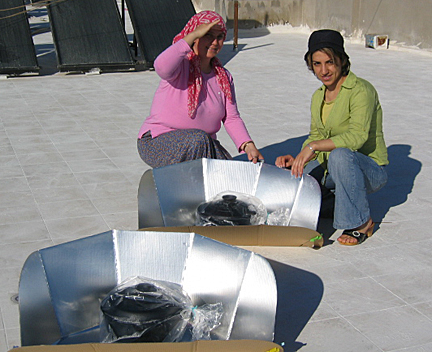 Longtime solar cooking advocate and trainer
Wilfred Pimentel, along with
Ken Goyer and
Cynthia Wee, led a two-day
"integrated cooking" workshop in Pambak,
Vanadzor,
Armenia last August. They taught three technologies: solar cookers,
fuel-efficient stoves and
heat-retention cookers. With access to these
complementary technologies, food can be cooked regardless of time of day and
season, and with a maximum of overall fuel savings. The group demonstrated
both panel-type and parabolic-type solar cookers, though the region's
altitude and climate limit the amount of solar cooking that can be done with
simple solar cookers.
Seventeen people from a number of
Armenian villages attended the workshop,
held at the Peace Corps training center. Each participant received a CooKit
and educational literature. They plan to return to their villages and begin
teaching others about integrated cooking. Contact: Wilfred Pimentel, 1035 East Cambridge, Fresno, California 93704,
USA. Tel: 559-222-4193, fax: 559-222-6450, e-mail:
solarcook@att.net
Longtime solar cooking advocate and trainer
Wilfred Pimentel, along with
Ken Goyer and
Cynthia Wee, led a two-day
"integrated cooking" workshop in Pambak,
Vanadzor,
Armenia last August. They taught three technologies: solar cookers,
fuel-efficient stoves and
heat-retention cookers. With access to these
complementary technologies, food can be cooked regardless of time of day and
season, and with a maximum of overall fuel savings. The group demonstrated
both panel-type and parabolic-type solar cookers, though the region's
altitude and climate limit the amount of solar cooking that can be done with
simple solar cookers.
Seventeen people from a number of
Armenian villages attended the workshop,
held at the Peace Corps training center. Each participant received a CooKit
and educational literature. They plan to return to their villages and begin
teaching others about integrated cooking. Contact: Wilfred Pimentel, 1035 East Cambridge, Fresno, California 93704,
USA. Tel: 559-222-4193, fax: 559-222-6450, e-mail:
solarcook@att.net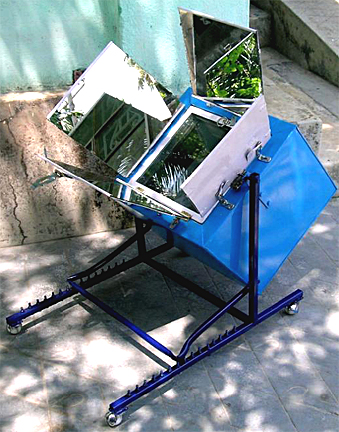 Sankha Subhra Datta has designed a solar box cooker that is suspended at two
points within a support frame, allowing for rotation of the entire cooker
around a horizontal axis from 5 to 70 degrees with respect to the ground.
The cooker can therefore maintain a nearly 90-degree angle to the light as
the sun's position in the sky changes. The cooker is rotated around a
horizontal axis by repositioning a bar that is attached to the lower front
corners of the box between any of 14 slots spread across the base of the
frame. Datta says this system has advantages over solar box cookers with
tilt-adjusting rear legs — a greater range of rotation can be achieved, and
the cook can rotate the unit smoothly without having to lift its entire
weight and risk food spillage. Another design feature that helps to prevent
food spills is the weighted, rotating cooking tray that keeps the pot
horizontal at all times. Regardless of cooker rotation, the pot is always at
the center of the cooker because the tray rotates on the horizontal axis of
the pot. "This tray holding arrangement is designed for proper utilization
of top and bottom reflectors at every inclination … which is not possible in
simply suspended tray arrangements [because] shifting of pot location from
the central position of the inner box due to the rotation of pot around
pivots," Datta says. The cooker frame sits on casters for easy rotation
around the vertical axis. The outer box is constructed of galvanized iron
and the inner box is aluminum, with glass wool insulation in between. The
glazing is double-paned glass with a two-centimeter air gap. Contact: Sankha Subhra Datta, Mohanta Para, PO & DIST.- Jalpaiguri,
West Bengal - 735 101,
India. E-mail:
sankhasubhradutta@yahoo.com or
datta.subhra@rediffmail.com
Sankha Subhra Datta has designed a solar box cooker that is suspended at two
points within a support frame, allowing for rotation of the entire cooker
around a horizontal axis from 5 to 70 degrees with respect to the ground.
The cooker can therefore maintain a nearly 90-degree angle to the light as
the sun's position in the sky changes. The cooker is rotated around a
horizontal axis by repositioning a bar that is attached to the lower front
corners of the box between any of 14 slots spread across the base of the
frame. Datta says this system has advantages over solar box cookers with
tilt-adjusting rear legs — a greater range of rotation can be achieved, and
the cook can rotate the unit smoothly without having to lift its entire
weight and risk food spillage. Another design feature that helps to prevent
food spills is the weighted, rotating cooking tray that keeps the pot
horizontal at all times. Regardless of cooker rotation, the pot is always at
the center of the cooker because the tray rotates on the horizontal axis of
the pot. "This tray holding arrangement is designed for proper utilization
of top and bottom reflectors at every inclination … which is not possible in
simply suspended tray arrangements [because] shifting of pot location from
the central position of the inner box due to the rotation of pot around
pivots," Datta says. The cooker frame sits on casters for easy rotation
around the vertical axis. The outer box is constructed of galvanized iron
and the inner box is aluminum, with glass wool insulation in between. The
glazing is double-paned glass with a two-centimeter air gap. Contact: Sankha Subhra Datta, Mohanta Para, PO & DIST.- Jalpaiguri,
West Bengal - 735 101,
India. E-mail:
sankhasubhradutta@yahoo.com or
datta.subhra@rediffmail.com 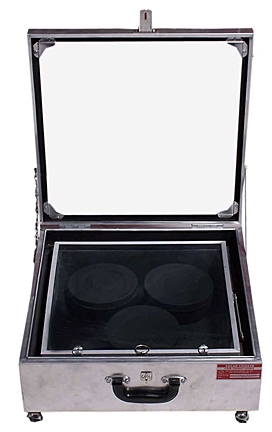 Fair Fabricators has been honored for its
"outstanding performance" in
India's solar cooker program. The award was sponsored by the governmental
Ministry of Non-conventional Energy Sources (MNES). Fair Fabricators reports
that it has manufactured and sold more than 100,000 solar cookers in the last
two decades. The company is a leading manufacturer of aluminum-bodied solar
box cookers, but also manufactures parabolic-type solar cookers and expects
to begin production of solar box cookers made of fiber-reinforced polymer
(FRP). Contact:
Mahendra Kumar Rawat, Fair Fabricators, 142 Tilak Nagar, Near Post
Office, Indore, Madhya Pradesh - 452 018, India. Tel/fax: +91-731-2491488,
e-mail: fairfabricators@rediffmail.com
Fair Fabricators has been honored for its
"outstanding performance" in
India's solar cooker program. The award was sponsored by the governmental
Ministry of Non-conventional Energy Sources (MNES). Fair Fabricators reports
that it has manufactured and sold more than 100,000 solar cookers in the last
two decades. The company is a leading manufacturer of aluminum-bodied solar
box cookers, but also manufactures parabolic-type solar cookers and expects
to begin production of solar box cookers made of fiber-reinforced polymer
(FRP). Contact:
Mahendra Kumar Rawat, Fair Fabricators, 142 Tilak Nagar, Near Post
Office, Indore, Madhya Pradesh - 452 018, India. Tel/fax: +91-731-2491488,
e-mail: fairfabricators@rediffmail.com
LATIN AMERICA AND IBERIA
Bolivia The
Center for Development of Solar Energy (CEDESOL) is working to install
2000 solar cookers and 2500 fuel-efficient, two-burner "rocket" stoves in
Bolivia by the end of May. Over the next 12 months it hopes to scale up to
15000 stoves and cookers. CEDESOL contributes to a campaign led by the
German aid group
GTZ to distribute 100000 solar cookers,
heat-retention
cookers, and fuel-efficient stoves by 2010.The GTZ campaign is to be
launched during an international seminar in La Paz this month. Contact: CEDESOL, P.O. Box 738, Cochabamba, Bolivia. E-mail:
david.cedesol@gmail.com El Sudcaliforniano newspaper of La Paz,
Mexico recently reported on a small solar
cooking project started by
Mercedes Gorrete Solis Lucero, a local
biochemical engineer. Thus far, 20 demonstration solar cookers have been
constructed — eight parabolic-type, six box-type and six panel-type. The
purpose of the project is to make solar thermal technology available to the
community at low cost while contributing to an ecological culture. The state
of Baja California Sur enjoys more than 260 sunny days per year, suffers
from scarcity of firewood and is home to people who tend to put new
technologies into practice, the newspaper says. Gorrete Solis Lucero
demonstrates the cookers at events such as the state government's women's
exposition She says most people become interested, show enthusiasm and ask
questions, and she has a special method for dealing with doubts. "I make
pastries," she says. In February,
Paraguay became the first country in Latin America to offer a
master's degree in Sustainable Development, Renewable Energy and Energy
Efficiency. Paraguay is following the lead of
Spain, which has offered such
a degree for five years. The degree is offered in response to global climate
change and strains on global energy supplies. The 18-month course will cover
themes such as sustainable development; energy management and efficiency;
solar, wind and hydro energy applications; bio-fuels; project evaluation
techniques; and economic management. The course contains both on-line and
traditional classroom components.
The course was organized by the UNESCO professorship in sustainability of
the Universitat Politècnica de Catalunya, the Universidad Nacional de
Asunción (UNA), and several other universities in Spain, Paraguay,
Nicaragua
and
Argentina. It is sponsored by the European Union's Urb-Al program, which
links interested urban and rural organizations from various European and
Latin American countries in decentralized cooperation networks. For more information about this course, contact Ing. Lisa Lugo (Universidad
Católica "Nuestra Señora de la Asunción") by e-mail:
lugo@uca.edu.py; or Ing.
Juan Carlos Silvero (UNA) by e-mail: jsilvero@ing.una.py
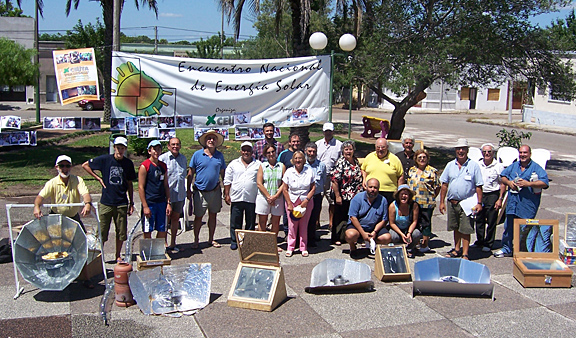 The third national solar energy conference was held in February in the city
of Guichon, Paysandú. Sponsored by the
Uruguayan Center of Appropriate
Technologies (CEUTA), delegates attended from all departments in the
country. Also attending were representatives of the National Bureau for the
Environment (DINAMA), U.N. Educational, Scientific and Cultural Organization
(UNESCO), and the municipal government of Paysandú. Solar cookers were on
display in Plaza Williman, where they could be seen by the general public.
The city of Guichon was the site of a workshop on construction and use of
solar cookers in 2004. Out of that gathering has grown the national solar
conferences. The fourth national conference will be held early in 2008. Contact:
Juan José Oña, Centro Uruguayo de Tecnologías Apropiadas, Santiago
de Chile 1183, 11200 Montevideo,
Uruguay. E-mail:
profauna@adinet.com.uy,
Web: www.ceuta.org.uy
The third national solar energy conference was held in February in the city
of Guichon, Paysandú. Sponsored by the
Uruguayan Center of Appropriate
Technologies (CEUTA), delegates attended from all departments in the
country. Also attending were representatives of the National Bureau for the
Environment (DINAMA), U.N. Educational, Scientific and Cultural Organization
(UNESCO), and the municipal government of Paysandú. Solar cookers were on
display in Plaza Williman, where they could be seen by the general public.
The city of Guichon was the site of a workshop on construction and use of
solar cookers in 2004. Out of that gathering has grown the national solar
conferences. The fourth national conference will be held early in 2008. Contact:
Juan José Oña, Centro Uruguayo de Tecnologías Apropiadas, Santiago
de Chile 1183, 11200 Montevideo,
Uruguay. E-mail:
profauna@adinet.com.uy,
Web: www.ceuta.org.uy
NORTH AMERICA AND EUROPE
Canada
"Bon Appétit Monsieur Soleil," a film about solar cooking in
Burkina Faso,
earned top honors and a 5000 euro prize at the International Ecological Film
Festival in Bourges,
France this past October. The film was directed by Boris Claret
and produced by Association La Trame documentary film studio. The festival
program described the film as follows: "At the edge of the Sahel, firewood
is rare and expensive. To counter deforestation, a whole network of
nongovernmental organizations, craftsmen welders, and women's associations
have developed for 10 years an effective alternative: parabolic solar
cookers."
For more information visit La Trame's Web site:
www.la-trame.org
Former SCI Executive Director
Bev Blum demonstrated solar cookers and built
solar CooKits at a conference titled "Killer in the Kitchen: Indoor Air
Pollution and Appropriate Technology Solutions" held last November in
Alabama. The purpose of the conference was two-fold: to spotlight the global
problem of indoor air pollution related to smoky cooking fires, and to
explore proven appropriate technology solutions. Several technologies were
presented, including fuel-efficient
"rocket" stoves,
heat-retention cookers,
and solar cookers.
Solar Oven Society's
Martha Port provided additional
information on solar cooking and solar water pasteurization. "There was a
strong consensus that the ideal way to address smoke hazards is integrated
introduction of fuel-efficient stoves, solar cookers and heat-retention
cookers," Blum writes. "It was a great experience." The conference was sponsored by Servants in Faith and Technology (SIFAT),
the Sparkman Center for Global Health, and the University of Alabama at
Birmingham Framework Program. SIFAT offers courses on a range of topics —
including appropriate technology, international health, and microenterprise
development — from a Christian perspective. Contact: Servants in Faith
and Technology, 2944 County Rd. 113, Lineville, Alabama 36266,
USA. Tel:
(256) 396-2015, fax: (256) 396-2501, e-mail:
info@sifat.org, Web: www.sifat.org
 The
Kyoto Twist Solar Cooking Society (KTSCS) continues its efforts to raise
funds for solar cooking projects that reduce poverty in sun-rich, fuel-poor
countries while reducing greenhouse gas emissions. (The "twist" part of the
name comes from the idea that those living in wealthier nations can change,
or twist, their priorities and lifestyles to better share limited resources
with those most in need.) KTSCS works with nongovernmental organizations
(NGOs) that have solar cooker experience and a proven track record in
countries where solar cookers are an appropriate technology. NGOs can
request an application packet for consideration of funding. Project
structure, recipient family selection parameters, training procedures, and
follow-up services must be described in detail. To monitor the effectiveness
of the projects, and to provide accountability to its donors, KTSCS will
track the success of recipient families, their financial savings due to
solar cooker use, and their greenhouse gas emission reductions.
KTSCS funded its first pilot project in November 2005. The group that
received funding —
Ananda Marga Universal Relief Team (AMURT) — has worked
in
Haiti for over 15 years and has experience conducting solar cooker
projects. "The Spirit of the Kyoto [Protocol] is international cooperation on what is
now being called the biggest challenge mankind has ever faced — massive and
rapid climate change," states the KTSCS Web site. "At an average cost of ten
dollars per tonne, donating to KTSCS is an effective way to help make a
difference. Cooking fires in the world today consume an estimated one
billion cubic meters of wood or biomass annually, which produces an
estimated one billion tonnes of carbon dioxide. Those are easy figures to
remember and very significant in the mitigation of global warming." Contact: Jack Anderson, The Kyoto Twist, Box 191, Lund, British Columbia
V0N-2G0, Canada. E-mail: jackanderson@prcn.org, Web:
www.kyototwist.org
The
Kyoto Twist Solar Cooking Society (KTSCS) continues its efforts to raise
funds for solar cooking projects that reduce poverty in sun-rich, fuel-poor
countries while reducing greenhouse gas emissions. (The "twist" part of the
name comes from the idea that those living in wealthier nations can change,
or twist, their priorities and lifestyles to better share limited resources
with those most in need.) KTSCS works with nongovernmental organizations
(NGOs) that have solar cooker experience and a proven track record in
countries where solar cookers are an appropriate technology. NGOs can
request an application packet for consideration of funding. Project
structure, recipient family selection parameters, training procedures, and
follow-up services must be described in detail. To monitor the effectiveness
of the projects, and to provide accountability to its donors, KTSCS will
track the success of recipient families, their financial savings due to
solar cooker use, and their greenhouse gas emission reductions.
KTSCS funded its first pilot project in November 2005. The group that
received funding —
Ananda Marga Universal Relief Team (AMURT) — has worked
in
Haiti for over 15 years and has experience conducting solar cooker
projects. "The Spirit of the Kyoto [Protocol] is international cooperation on what is
now being called the biggest challenge mankind has ever faced — massive and
rapid climate change," states the KTSCS Web site. "At an average cost of ten
dollars per tonne, donating to KTSCS is an effective way to help make a
difference. Cooking fires in the world today consume an estimated one
billion cubic meters of wood or biomass annually, which produces an
estimated one billion tonnes of carbon dioxide. Those are easy figures to
remember and very significant in the mitigation of global warming." Contact: Jack Anderson, The Kyoto Twist, Box 191, Lund, British Columbia
V0N-2G0, Canada. E-mail: jackanderson@prcn.org, Web:
www.kyototwist.org 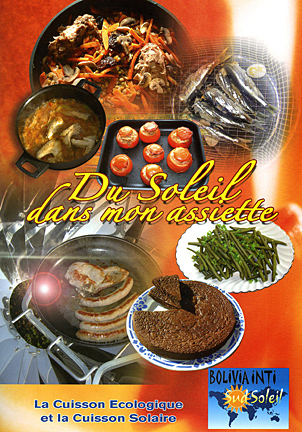 In October 2005 the association
Bolivia Inti-Sud Soleil held a national
conference on the development and dissemination of ecological cooking
methods in Africa, including solar cookers. More than 120 individuals and
organizations took part in the conference and participated in a series of
round-table discussions and workshops about project development,
implementation, evaluation and sustainability.
Highlights from the conference and from several ecological cooking projects
in Africa are available in a French-language publication for 2 euro. The
publication is free for Bolivia Inti members. Contact:
Vincent Dulong, Bolivia Inti-Sud Soleil, 1 rue Julien Grolleau,
44200 Nantes, France. Tel: 02 51 86 04 04, e-mail:
vincent.dulong@sud-soleil.org, Web:
www.boliviainti.org.
Also available from Bolivia Inti-Sud Soleil is a new French-language solar
cookbook titled "Du Soleil dans mon assiette." Fifty recipes, ranging from
appetizers to main dishes to desserts, are nicely presented in this book
along with full-color pictures. Several of the recipes also include tips for
cooking with fuel-efficient wood stoves and heat-retention cookers. The book
sells for 12.50 euro ($16) plus shipping. Proceeds benefit the
organization's projects in Andean countries. Contact: Bolivia Inti-Sud Soleil, 41 rue du Château d'eau, 44240 La Chapelle
sur Erdre, France. Tel/fax: 02 40 72 05 30, e-mail:
soleil@boliviainti.org,
Web: www.boliviainti.org
In October 2005 the association
Bolivia Inti-Sud Soleil held a national
conference on the development and dissemination of ecological cooking
methods in Africa, including solar cookers. More than 120 individuals and
organizations took part in the conference and participated in a series of
round-table discussions and workshops about project development,
implementation, evaluation and sustainability.
Highlights from the conference and from several ecological cooking projects
in Africa are available in a French-language publication for 2 euro. The
publication is free for Bolivia Inti members. Contact:
Vincent Dulong, Bolivia Inti-Sud Soleil, 1 rue Julien Grolleau,
44200 Nantes, France. Tel: 02 51 86 04 04, e-mail:
vincent.dulong@sud-soleil.org, Web:
www.boliviainti.org.
Also available from Bolivia Inti-Sud Soleil is a new French-language solar
cookbook titled "Du Soleil dans mon assiette." Fifty recipes, ranging from
appetizers to main dishes to desserts, are nicely presented in this book
along with full-color pictures. Several of the recipes also include tips for
cooking with fuel-efficient wood stoves and heat-retention cookers. The book
sells for 12.50 euro ($16) plus shipping. Proceeds benefit the
organization's projects in Andean countries. Contact: Bolivia Inti-Sud Soleil, 41 rue du Château d'eau, 44240 La Chapelle
sur Erdre, France. Tel/fax: 02 40 72 05 30, e-mail:
soleil@boliviainti.org,
Web: www.boliviainti.org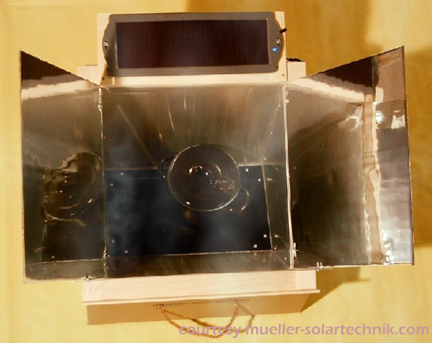 The
Mueller Solartechnik company will soon release its latest solar box
cooker,
Zèbre. It has two opposing reflectors that automatically adjust
throughout the day to track the movement of the sun, using a microcomputer
powered by photovoltaic cells. This allows for constant temperatures to be
maintained over extended periods of time without manual adjustment. Due to
the design of the cooker and placement of the reflectors, it is recommended
primarily for those in equatorial regions. Contact: Mueller Solartechnik, Obergasse 33, 55234 Offenheim,
Germany. Tel:
+49 162 278 9718, fax: +49 6173 66852, e-mail:
mueller-solartechnik@gmx.net,
Web: www.mueller-solartechnik.com
The
Mueller Solartechnik company will soon release its latest solar box
cooker,
Zèbre. It has two opposing reflectors that automatically adjust
throughout the day to track the movement of the sun, using a microcomputer
powered by photovoltaic cells. This allows for constant temperatures to be
maintained over extended periods of time without manual adjustment. Due to
the design of the cooker and placement of the reflectors, it is recommended
primarily for those in equatorial regions. Contact: Mueller Solartechnik, Obergasse 33, 55234 Offenheim,
Germany. Tel:
+49 162 278 9718, fax: +49 6173 66852, e-mail:
mueller-solartechnik@gmx.net,
Web: www.mueller-solartechnik.com
 A couple of years ago,
Brit Bakken Oedegaard happened upon the
Solar Cooking
Archive while researching garden plants on the
Internet. She had some free time, and decided to build a couple of the solar
cookers from plans on the site. She built a solar CooKit and a
Reflective
Open Box (ROB) cooker. Living in
Norway, at 57 degrees north of the equator, Oedegaard didn't expect that she'd be able to do any real solar cooking, but
she thought it would be a fun experiment.
A couple of years ago,
Brit Bakken Oedegaard happened upon the
Solar Cooking
Archive while researching garden plants on the
Internet. She had some free time, and decided to build a couple of the solar
cookers from plans on the site. She built a solar CooKit and a
Reflective
Open Box (ROB) cooker. Living in
Norway, at 57 degrees north of the equator, Oedegaard didn't expect that she'd be able to do any real solar cooking, but
she thought it would be a fun experiment.
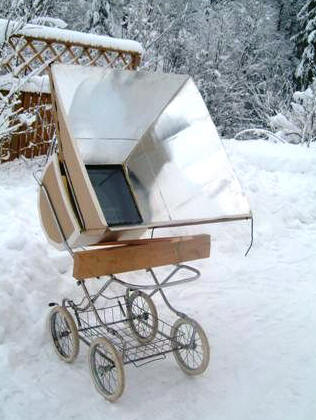
 The ROB brought water to a boil and the
CooKit heated water to 91°C. These
achievements were made in late February, with snow on the ground and an
ambient temperature slightly above freezing. Encouraged by the results, she
built other cookers, including a SunStar and a
12-sided Parvati. Oedegaard
and her husband used tables, metal stands, and even a baby carriage to hold
the cookers above the snow and to angle the cookers toward the low winter
sun.
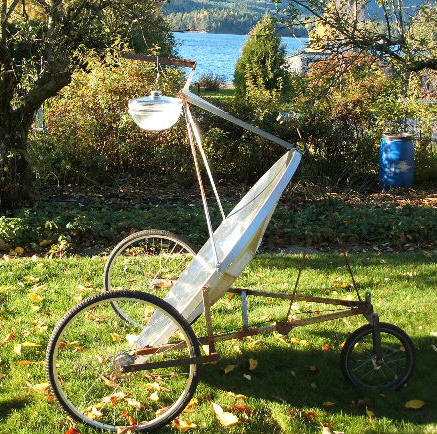
Using a homemade stand and a discarded
satellite television dish, Oedegaard
constructed a parabolic-type solar cooker that boiled a liter of water in 14
minutes — in late October, when the sun was low and the ambient temperature
only 7°C. "I think this certainly proves that solar cooking is not only for
hot climates," Oedegaard writes, "and I hope people who live in
Canada, Northern Europe and Northern Asia will learn to use the energy
from the sun in more ways than we thought possible earlier."
The ROB brought water to a boil and the
CooKit heated water to 91°C. These
achievements were made in late February, with snow on the ground and an
ambient temperature slightly above freezing. Encouraged by the results, she
built other cookers, including a SunStar and a
12-sided Parvati. Oedegaard
and her husband used tables, metal stands, and even a baby carriage to hold
the cookers above the snow and to angle the cookers toward the low winter
sun.
Using a homemade stand and a discarded
satellite television dish, Oedegaard
constructed a parabolic-type solar cooker that boiled a liter of water in 14
minutes — in late October, when the sun was low and the ambient temperature
only 7°C. "I think this certainly proves that solar cooking is not only for
hot climates," Oedegaard writes, "and I hope people who live in
Canada, Northern Europe and Northern Asia will learn to use the energy
from the sun in more ways than we thought possible earlier." 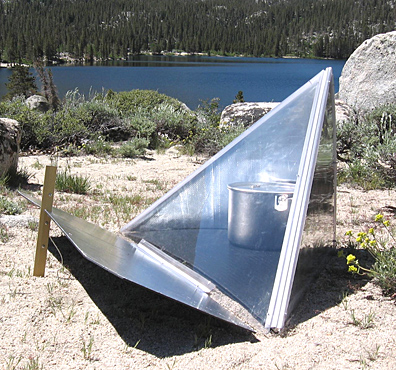 ClearDome Solar Thermal is adding a new product to its line of solar
cookers: the
SolaReflex Pyramid. As its name implies, the cooker is shaped
like a pyramid. It consists of a base, three sides, and an adjustable front
reflector. The removable, washable base is made of a non-toxic,
heat-absorbing black plastic. Two of the three polycarbonate sides are lined
with ClearDome's highly-reflective SolaReflex foil, while the third side is
transparent. The cooker's designer, Deris Jeannette, calls the cooker "an
enclosed panel-type solar cooker." Like most panel-type cookers, the SolaReflex Pyramid does not have to be rotated frequently since it accepts
sunlight from a wide range of angles. Unlike most panel-type cookers,
however, it is fully enclosed and therefore does not require the use of a
transparent cooking bag. The SolaReflex Pyramid comes in two sizes: a
one-liter model that stands 30 centimeters tall, and a four-liter model that
stands 45 centimeters tall. Both are available in collapsible and
non-collapsible forms. Larger models may be available in the future. Contact: ClearDome Solar Thermal, 3368 Governor Dr., 153-F, San Diego,
California 92122, USA. Tel: 619-990-7977, e-mail:
cleardomesolar@sbcglobal.net, Web:
www.cleardomesolar.com
ClearDome Solar Thermal is adding a new product to its line of solar
cookers: the
SolaReflex Pyramid. As its name implies, the cooker is shaped
like a pyramid. It consists of a base, three sides, and an adjustable front
reflector. The removable, washable base is made of a non-toxic,
heat-absorbing black plastic. Two of the three polycarbonate sides are lined
with ClearDome's highly-reflective SolaReflex foil, while the third side is
transparent. The cooker's designer, Deris Jeannette, calls the cooker "an
enclosed panel-type solar cooker." Like most panel-type cookers, the SolaReflex Pyramid does not have to be rotated frequently since it accepts
sunlight from a wide range of angles. Unlike most panel-type cookers,
however, it is fully enclosed and therefore does not require the use of a
transparent cooking bag. The SolaReflex Pyramid comes in two sizes: a
one-liter model that stands 30 centimeters tall, and a four-liter model that
stands 45 centimeters tall. Both are available in collapsible and
non-collapsible forms. Larger models may be available in the future. Contact: ClearDome Solar Thermal, 3368 Governor Dr., 153-F, San Diego,
California 92122, USA. Tel: 619-990-7977, e-mail:
cleardomesolar@sbcglobal.net, Web:
www.cleardomesolar.com 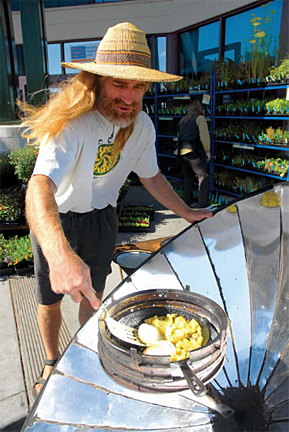
For more than a decade,
Bart Orlando has volunteered at Humboldt State
University's Campus Center for Appropriate Technology. He helps students
build and utilize human-powered machines. He is also a long-time solar cook
who frequently demonstrates solar cooking outside the Arcata Co-op in
Arcata, California. He often shares the solar-cooked food with homeless
people in the area. Orlando says his homemade parabolic solar cooker could
cook over 100 servings of rice on a good day.
[Excerpted from a September 2006 Eureka Reporter story.] 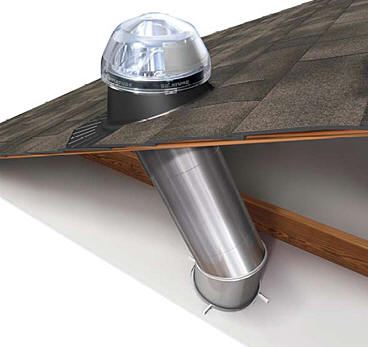 Introducing
the "Solatube-Tulsi Hybrid Indoor Solar Cooking Oven" concept.
Harvey Sherback is interested in combining solar cooking with skylights — in
particular a skylight called the Solatube. The Solatube would capture light
from the roof and direct it down a highly reflective cylinder to a Tulsi
Hybrid Solar Cooking Oven. Some structural modifications to the house would
be required. Solatube information is on-line at www.solatube.com; Tulsi
Hybrid information is on-line at www.sunbdcorp.com.
Contact: Harvey Sherback by e-mail:
harveysherback@yahoo.com [Editor's note: the Tulsi Hybrid and other products can be
purchased on-line.]
Introducing
the "Solatube-Tulsi Hybrid Indoor Solar Cooking Oven" concept.
Harvey Sherback is interested in combining solar cooking with skylights — in
particular a skylight called the Solatube. The Solatube would capture light
from the roof and direct it down a highly reflective cylinder to a Tulsi
Hybrid Solar Cooking Oven. Some structural modifications to the house would
be required. Solatube information is on-line at www.solatube.com; Tulsi
Hybrid information is on-line at www.sunbdcorp.com.
Contact: Harvey Sherback by e-mail:
harveysherback@yahoo.com [Editor's note: the Tulsi Hybrid and other products can be
purchased on-line.]
Darfur refugees keep on cookin'
By Derk Rijks, project leader
 In
Iridimi refugee camp in
Chad about 17000 refugees from Darfur,
Sudan have
found temporary shelter. This camp is situated in a semi desert region at 15° N,
where rainfall is irregular and usually less than 120 millimeters per year. As a
result, the land is seasonally and sparsely covered with grasses. Shrubs and
trees only grow on the edges of wadis — dry riverbeds that carry water a few
days a year.
In
Iridimi refugee camp in
Chad about 17000 refugees from Darfur,
Sudan have
found temporary shelter. This camp is situated in a semi desert region at 15° N,
where rainfall is irregular and usually less than 120 millimeters per year. As a
result, the land is seasonally and sparsely covered with grasses. Shrubs and
trees only grow on the edges of wadis — dry riverbeds that carry water a few
days a year.
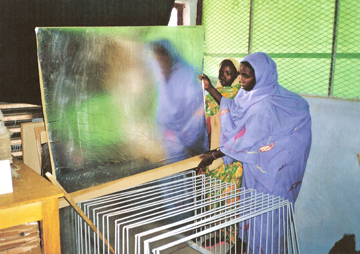
While firewood for cooking was sufficient for the few small, dispersed villages located along the wadis, it was not nearly enough for a sudden influx of thousands of refugees. After Iridimi camp was established, the U.N. High Commissioner for Refugees (UNHCR) imported a limited supply of firewood, so women roamed the countryside for more. Indigenous villagers saw this as a threat to their own supply. With more than 330 sunny days each year in the camp, it seemed to me that solar cookers could provide some relief.
We decided to use solar CooKits due to their ease of use and potential for local manufacture and maintenance by refugees. After conducting a series of well-received demonstrations, we formulated a project outline and sought funding for materials and remuneration of trainers and refugee helpers. Chadian citizens Marie-Rose Neloum and Gilhoube Patallet led trainings, managed supplies and funds, and provided general support.
 After a short period of hesitation, the Iridimi women were convinced that the
sun could cook. They embraced solar cooking wholeheartedly. Even most men are
now happy with the new techniques, though the final decision clearly rests with
the women! Virtually all of their traditional meals can be made with solar
cookers.
After a short period of hesitation, the Iridimi women were convinced that the
sun could cook. They embraced solar cooking wholeheartedly. Even most men are
now happy with the new techniques, though the final decision clearly rests with
the women! Virtually all of their traditional meals can be made with solar
cookers.
During normal security conditions about 1000 CooKits are produced each month by a rotation of 20 "artisans," two from each camp zone. A workshop was built for this purpose. Forty refugee women are trained as auxiliary trainers, and in groups of two they teach six women each week how to solar cook. There are more than 4500 women in the camp, of which over 2500 have received training. Once trained, the women each receive two to three CooKits and pots, depending on family size.
The project has suffered twice from a slow-down in activity because of security concerns. The daily meal strategy adopted by UNHCR is as follows: breakfast, cooked on improved woodstoves with UNHCR-distributed firewood; lunch, cooked in solar cookers; and dinner, cooked in solar cookers and/or heat-retention cookers (also known as "hay baskets," these are insulated enclosures in which is set a pot of food that has been brought to a boil, allowing it to continue to cook after being removed from its heat source.) The heat-retention cookers are woven by the refugee women, using materials that are brought in from other parts of the country.
Refugee-defined benefits from solar cooking include:
- "We keep clean, do not have tears in our eyes and have no running noses from smoke"
- "We do not have to go and look for firewood in far away places where we do not want to go (for safety reasons)"
- "There is no fire danger for our children or our tents"
- "We can use the saved firewood collection time to do handiwork (for sale and buying extra food or milk), to be with our children, or to learn from the classes taught in the camp"
At one point, in our absence, an independent subcontractor with UNHCR decided
arbitrarily and without consultation to halt solar cooking trainings because the
majority of the older women had been trained. There was a camp-wide protest that
was immediately resolved upon our return. Now, training is guaranteed for those
15 years and older, though we do not check ages and are happy to train younger
girls pretending to be 15! Women in many other regional refugee camps have
expressed great interest in having their own solar cooking projects, and
UNHCR has given its support to the idea.
Contact Derk Rijks by e-mail:
rijks.agrometeo@wanadoo.fr
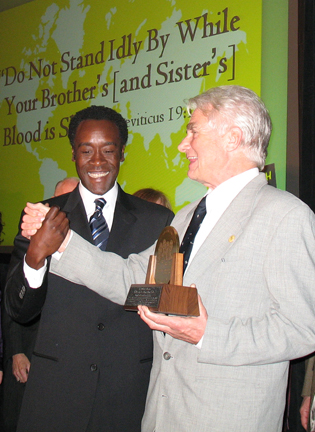
Editor's note: Last month, Rijks, Neloum and Patallet received the 2007 Prize
for Humanity, presented by the Immortal
Chaplains Foundation. The award honors those who "risked all to protect others
of a different faith or ethnic origin." The
award was presented in Long Beach, California (USA) by Oscar-nominated actor Don
Cheadle, known for his activism on behalf
of the victims of the Darfur crisis. For more information about the Immortal
Chaplains Foundation visit its Web site:
www.immortalchaplains.org.
Message from the Executive Director
By Patrick Widner, SCI executive director
 Recently I attended a workshop that included a discussion about another
Superpower on earth, this one made up of
Recently I attended a workshop that included a discussion about another
Superpower on earth, this one made up of
nongovernmental organizations, community-based organizations and individuals
that focus on equality for humanity, social
justice and the environment. Another way of looking at this positive force is as
an immune system for what ails the planet.
This Superpower concept manifested itself at an event honoring Derk Rijks,
Marie-Rose Neloum, and Gilhoube Patallet. (See
"Darfur refugees keep on cookin'.") All of them were recognized by the Immortal
Chaplains Foundation as recipients of the
2007 Prize for Humanity for their work in the Iridimi refugee camp in Chad. Paul
and Tatiana Rusesabagina of "Hotel Rwanda"
fame were present, and Desmond Tutu and Jane Goodall sent special taped messages
for the event.
Derk Rijks, representative of the Netherlands-based nonprofit KoZon Foundation
and an associate of Solar Cookers
International (SCI) and Jewish World Watch, introduced the CooKit to Darfur
refugees at Iridimi camp in 2005. Rijks will now
expand this work into other camps. His involvement, and that of his African
colleagues who were honored, have made a safer
life for so many families. I felt honored and humbled to be in the presence of
these courageous people.
In reflecting on the above, the symbolism of an Afghan proverb sent by Patricia McArdle — qatra qatra daryaa mesha / drop by drop it becomes a river — is most appropriate when thinking about SCI. We have six volunteers at the office today adding their drops. Three of the volunteers are students packing CooKits and WAPIs and one is a teacher who taught her students to make solar cookers. At the same time, volunteer SCI advocates in New York, Washington, D.C., and Geneva are preparing for the upcoming fourth session of the Human Rights Council at the United Nations. Countless others throughout the world are promoting the use of the sun's energy through teaching and demonstrations of simple technologies for solar cooking and water pasteurization.
Thanks to all of you who have added to the river.
Let it rain! Except, when we are solar cooking.

Patrick T. Widner
SCI Executive Director
SCI Association: ready to be heard
Compiled by Bev Blum, SCIA secretariat
 The
Solar Cookers International Association (SCIA), an umbrella organization of
Solar Cookers International (SCI), has grown
rapidly since its formation at the 2006 international solar cookers conference
last July. SCIA members are now ready to
speak with a strong, unified voice on behalf of wider access to solar cooking,
solar pasteurizing and solar food processing.
Wider access will be accomplished through more partnerships with U.N. agencies,
international development and relief
organizations, policy makers, businesses, and networks related to women, health
and energy.
The
Solar Cookers International Association (SCIA), an umbrella organization of
Solar Cookers International (SCI), has grown
rapidly since its formation at the 2006 international solar cookers conference
last July. SCIA members are now ready to
speak with a strong, unified voice on behalf of wider access to solar cooking,
solar pasteurizing and solar food processing.
Wider access will be accomplished through more partnerships with U.N. agencies,
international development and relief
organizations, policy makers, businesses, and networks related to women, health
and energy.
Ninety-nine individuals and 56 organizations from 32 countries joined the SCIA
during 2006, making them founding members. A
17-member steering committee elected
David Whitfield, of the
Center for
Development of Solar Energy (CEDESOL) in Cochabamba,
Bolivia, as its chairperson.
 While acknowledging that SCIA members have diverse opinions on specific
strategies, programs and devices, the steering
committee identified a number of statements that are agreed upon:
While acknowledging that SCIA members have diverse opinions on specific
strategies, programs and devices, the steering
committee identified a number of statements that are agreed upon:
- In sun-rich areas, solar cookers are improving people's health, economics and environments
- Solar cookers are urgently needed by people in fuel-scarce, sun-rich areas
- Solar cookers complement, but don't replace other cooking methods
- Virtually all foods can be cooked equally or better in one or more types of solar cookers
- Solar cookers are clean and pollution-free; most are also safer than fire, and save time and money
- Solar cookers provide a number of documented benefits for cooking, pasteurizing and food processing across the globe
Regional networks and action group updates
The Asia and Oceania network will meet in Kathmandu, Nepal on 16-17 April, 2007. Paper submissions are due 15 March. No travel assistance is available, but registration and other costs are modest. For details contact host organization Center for Rural Technology/Nepal by e-mail: asiarwscfp@crtnepal.org. To participate in the Asia and Oceania network, contact Jimmy McGilligan by e-mail: solarnetworkasia@gmail.com.
Latin America and Iberia network member Pedro Serrano, of the El Canelo de Nos organization, has many projects with the U.N. Development Program (UNDP) in Chile, and hopes to garner its support for actions throughout Latin America. To participate in the Latin America and Iberia network, contact Pedro Serrano by e-mail: pedro.serrano@usm.cl.
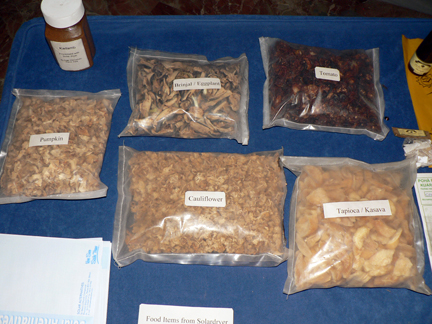 The Advocacy group, headed by
Dr. Sonia Heptonstall of Geneva, has increased
communication among top solar cooker advocates
in Geneva, New York and Washington, D.C. Group members contributed to meetings
of the U.N. Commission on Sustainable
Development in New York, and will attend World Health Organization (WHO)
meetings in Geneva.
The Advocacy group, headed by
Dr. Sonia Heptonstall of Geneva, has increased
communication among top solar cooker advocates
in Geneva, New York and Washington, D.C. Group members contributed to meetings
of the U.N. Commission on Sustainable
Development in New York, and will attend World Health Organization (WHO)
meetings in Geneva.
The Solar Food Processing and Conservation group,
coordinated by Rolf
Behringer
of the
International Solar Energy Society
(ISES), has produced an interesting general information brochure with real-world
examples. The brochure is available on-line
at www.solarfood.org in English, Chinese, French, Spanish and German languages.
If you have an income-generating solar food
project please consider submitting its details on the same Web site.
Education group member Rowena Gerber will be presenting at the 2nd annual Celebration of Teaching and Learning in New York City on 22-23 March. Dubbed the "World's Fair for educators," this year's event will focus on science and global awareness.
Sun Ovens International's Paul Munsen will join Gerber, as will several of her students. Gerber will demonstrate, in her words, "just about every type of solar oven ever made." Former U.S. Vice President Al Gore will also be speaking at the event.
Observable solar cooking communities
Association member (and new SCI board member)
Patricia McArdle put out a call
for communities worldwide that have 100+ solar
cooking families clustered enough that it would be reasonable for them to
receive visitors. Thus far, 25 communities in
eight countries have been identified. (The two
Afghanistan communities have less
than 100 families.) Note that five of eight
countries are in Asia, where fuel scarcities appeared earliest. For more
information, or to add a community, send an e-mail
to Bev Blum: association@solarcookers.org.
AFGHANISTAN
- Qalai Badar Khan
- Faizabad
CHINA
- Chengdu, Sichuan
- Lanzhou, Gansu
INDIA
- Andhra Pradesh (state, three villages)
KENYA
- Nyakach, Nyanza
MEXICO
- Sierra Gorda, Queretero
- Oaxaca (state)
- Puebla (state)
NEPAL
- Siddhipur
- Nayapati
- Ghamcha
- Sunakoti
- Machhe Gaon
- Kathmandu
- Bamti Bhandar
- Jumla
- Buthanese refugee camps
TURKEY
- Yakapinar (formerly Misis), Adana
UGANDA
- Kikokwa
- Ruharo
- Biharwe
- Mbarara (district,
Orukiga refugee settlement)
|
Founding organizations of the Solar Cookers International Association
|
Founding members
|
by Patricia McArdle, SCI board of directors
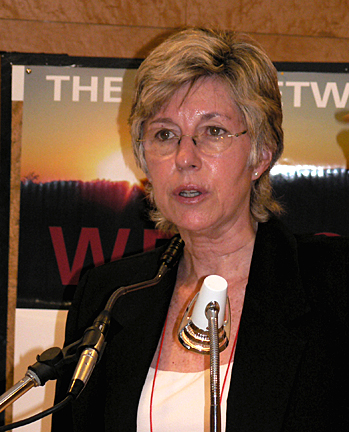 In 2005 I served as the U.S. government representative at a British Army-run
Provincial Reconstruction Team in Northern
Afghanistan. I had heard of solar
cookers before I went to Afghanistan, but I knew little about them or their
incredible potential to save forests, reduce pollution and improve the lives of
millions of women.
In 2005 I served as the U.S. government representative at a British Army-run
Provincial Reconstruction Team in Northern
Afghanistan. I had heard of solar
cookers before I went to Afghanistan, but I knew little about them or their
incredible potential to save forests, reduce pollution and improve the lives of
millions of women.
My solar cooker epiphany occurred on a cold but sunny March day while on patrol in the Hindu Kush with one of our military observation teams. During my travels around northern Afghanistan, I had observed that there were almost no trees and little groundcover left in the region. People told me that the trees had been cut down for firewood or to make charcoal. As we drove that morning up a narrow mountain trail to a remote village for a meeting with local officials, we passed a group of young (five-seven year old) children leading donkeys down the trail.
After our meeting, the soldiers and I were given a tour of the village. The district governor showed us the one remaining “forest” in the area, a small grove of cedar and pine growing just above the village. It was guarded night and day to prevent the trees from being cut down for firewood. The governor explained to us that if they lost their “forest,” the next big rain would wash away the village. I was also invited into one of the family compounds and introduced to the women who were cooking lunch over a smoky fire fueled with what looked like tumbleweed stacked in a huge pile next to their mud-walled hut.
At the end of the day, heading down the mountain, we again passed the children, who were on their way home. Their donkeys were barely visible under enormous bundles of the same “tumbleweed” I had seen the women cooking with. As we traveled west into the glare of the setting sun, I thought to myself, “Someone should tell these people about solar cookers.” Since I didn’t know much about solar cookers myself, I did some research.
That night, back at our camp in Mazar-e Sharif, I trolled the Internet for information on solar cookers and was astounded at the number of Web sites I found. I spent the next few evenings learning about this remarkably simple technology. Eventually I downloaded several plans, and asked the British Army kitchen staff for some old cardboard boxes, aluminum foil and flour to make paste. With the help of the soldiers, I constructed five different box- and panel-type solar cookers. We took them up to the roof of our heavily guarded compound and, over a period of several weeks, tested them and measured the results. The solar “CooKit” won the competition.
It was clear to me that there was a great potential in this country for the widespread distribution of solar cookers to:
- Reduce the amount of time children spend foraging for fuel
- Reduce erosion caused by a lack of ground cover (and the resulting flooding)
- Cut down on the amount of smoke that women are exposed to while cooking
I hoped to return eventually to the village that had inspired me to learn about
solar cookers, to demonstrate the CooKit and see how the people would react to
this remarkable technology. Four months later, we went back.
It was another cool, sunny day. A small group of men standing in front of the
governor’s house watched in silence as we arrived for our meeting. (Women are
not allowed out in public unless the gathering is all female). Before going in
to see the governor, I poured a bottle of water into a black pot, put the pot
inside a transparent oven bag, placed the bag in my homemade CooKit, turned the
CooKit to face the sun and went inside with the soldiers.
When we came out of the meeting 90 minutes later, the pot was steaming and the crowd had swelled from 10 to about 40 men. They were scratching their beards, pointing at the CooKit and trying to figure out how this piece of cardboard covered with shiny paper was able to boil water. Where was the fire? It looked to them like magic even after I explained how it worked. The pot was clearly very hot, but the cardboard and aluminum foil were not. How could this be? They all insisted on coming up to touch the very hot pot and then the cool foil-covered cardboard to confirm what they were seeing.
One of the men exclaimed, “We could make our tea with this!” The others nodded enthusiastically. Another said he would be able to find cardboard, but “where,” he asked, “do I get that shiny paper?” They all looked at me in silence, waiting for an answer. I wasn’t certain how to reply, because I knew that aluminum foil was not sold anywhere but Kabul, which was more than 100 miles to the south over the Hindu Kush.
Another man smiled, reached into his back pocket and took out a pack of cigarettes. He pulled up the inner foil liner and shouted, “We could use this!” The other men nodded, and several more pulled out their own cigarette packs to examine the foil liners. Within five minutes, these men had figured out a use for this technology and they had discovered a way to manufacture it using a locally available resource. None of them suggested that their wives might be able to cook meals with this technology, but I was still very impressed with their positive and creative reaction to my very brief demonstration. If they only used the CooKit for heating tea water, they would still dramatically reduce the biomass consumption of their village.
I began inquiring about solar cooker projects in Afghanistan and found that only Gordon Magney, who has distributed several hundred “SOS Sport” solar box cookers , was currently involved with solar cookers there. (I learned later that Sun Ovens International had, several years earlier, distributed solar cookers in Afghanistan.) Magney gave me a detailed proposal for another solar cooker project. I tried to generate support for his project within our embassy and U.S. Agency for International Development (USAID) mission, but, sadly, was not successful.
I have told this story and given solar cooker presentations many times at the U.S. State Department, the Peace Corps, USAID and elsewhere since my return from Afghanistan. Currently the U.S. government is partially funding only one solar cooker project, with Solar Household Energy (SHE) in Mexico. I plan to continue working to convince my colleagues in the government to support the spread of solar cooker technology around the world.
Show your support with a stamp
 |
Martin Almada reports that Paraguay has issued a postage stamp featuring a solar cooker. He feels the stamp is an advance in spreading awareness of solar cookers, and will contribute to environmental protection and energy conservation. He hopes that organizations elsewhere will follow this example and encourage creation of solar postage stamps in their own countries. |
 |
In 2004, Tanzania Posts Corporation released a series of postage stamps commemorating the 75th anniversary of Girl Guiding in Tanzania. Included in the set was a stamp depicting Girl Guides “demonstrating environment friendly solar cookers.” |
Another world is possible … with solar cooking!
by Margaret Owino, SCI eastern Africa director
Another world is possible! This was the message at the 2007 World Social Forum held in Nairobi on 20-26 January, 2007. This short, clear message was there for world movers to see, hear and deliberate on. People from all over the world came, bearing one message or another, and Solar Cookers International (SCI) was there, too.
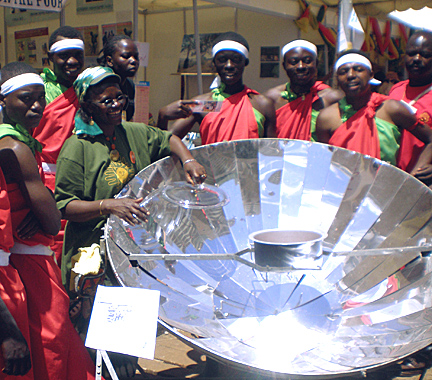 The Forum was filled with speeches, discussions, exhibits, dances and music.
SCI displayed three major types of solar cookers: concentrator cookers, box
cookers and panel cookers, including SCI's
CooKit. The cookers were used over
four days to demonstrate that another world is possible by using the sun's
energy to fulfill a basic need — the need for clean, free energy to cook food
and pasteurize drinking water.
The Forum was filled with speeches, discussions, exhibits, dances and music.
SCI displayed three major types of solar cookers: concentrator cookers, box
cookers and panel cookers, including SCI's
CooKit. The cookers were used over
four days to demonstrate that another world is possible by using the sun's
energy to fulfill a basic need — the need for clean, free energy to cook food
and pasteurize drinking water.
Many exhibitors had products to sell, but SCI was there to talk about solar
cooking, to show people what solar cookers are and how they work, and to share
with them the flavorful, nutritious rewards of a solar-cooked dish. All doubts
were swept away as people sampled roasted peanuts, doughnuts, cakes, roast meat
and local Kenyan dishes such as Ugali and Githeri.
Flanked by our Swiss friends Roland and Monica Baumann and Schmid Bonhard, who
brought a beautiful solar box cooker with them, and supported by Pax Romana, a
church group that let us use their stand, we made good use of the opportunity. Forum participants went away with new solar cooking knowledge, new memories in
their cameras, and sometimes even new CooKits. They also went away convinced
that another world is possible … with solar cooking.
California High School raises money for Darfur refugees
Solar Cookers International (SCI) received this kind letter from a local high school student, along with a donation in support of solar cooking. SCI would like to express its gratitude for the initiative taken by these young adults:
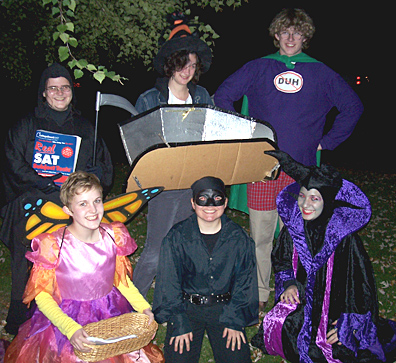 Enclosed is a donation from the members of
Mira Loma High School’s new Solar
Cooking Club. This year, we have been working to spread solar cooking in our
school community as well as raising money for Solar Cookers International’s
Darfur relief effort. We have had several fundraisers so far. In September, we
sold solar-cooked chili dogs at school. We also had a booth at the Salmon
Festival, and on Halloween we went trick-or-treating for donations of spare
change and handed out flyers on solar cooking. We intend to do more fundraising
in the spring.
Enclosed is a donation from the members of
Mira Loma High School’s new Solar
Cooking Club. This year, we have been working to spread solar cooking in our
school community as well as raising money for Solar Cookers International’s
Darfur relief effort. We have had several fundraisers so far. In September, we
sold solar-cooked chili dogs at school. We also had a booth at the Salmon
Festival, and on Halloween we went trick-or-treating for donations of spare
change and handed out flyers on solar cooking. We intend to do more fundraising
in the spring.
The members of the Solar Cooking Club are eager to help SCI in other ways too, so please contact us about any volunteer activities that are suitable for a group of high school students. On behalf of all members, I would like to offer my support for SCI's mission of spreading solar cooking in our community and around the world.
Sincerely,
Molly B
Solar cooker workshop announcement
Solar Cookers International is hosting a solar cooker workshop, at which participants will:
- Learn to make solar cookers
- Learn to cook food using free, clean solar energy
- Learn to test and solar pasteurize water
These skills may come in handy someday!
Date: 2 June, 2007
Time and Location: To be determined (Sacramento, California, USA)
Fee: $45, includes supplies
To register, contact Katie Sisay by e-mail:
katie@solarcookers.org or tel: (916)
455-4499.
Calling all U.S. federal employees!
 Over
one million U.S. federal employees participate annually in the Combined Federal
Campaign (CFC): the world’s largest workplace giving campaign. This year federal
employees have the option of supporting Solar Cookers International (SCI) with a
one-time gift or recurring payroll deductions through the Aid to Africa
Federation. SCI is proud to qualify for CFC’s rigorous financial, accountability
and governance standards. (CFC #9985.)
Over
one million U.S. federal employees participate annually in the Combined Federal
Campaign (CFC): the world’s largest workplace giving campaign. This year federal
employees have the option of supporting Solar Cookers International (SCI) with a
one-time gift or recurring payroll deductions through the Aid to Africa
Federation. SCI is proud to qualify for CFC’s rigorous financial, accountability
and governance standards. (CFC #9985.)
More information is available on the Internet:
www.africacharities.org/index.shtml.
 I would like to inform you that I will step down from my current position as
Director of International Program Development on 30 March, 2007. It has been my
pleasure to meet and correspond with so many of you over the last five and a
half years. I admire your commitment to spreading solar cooking and confidence
in Solar Cookers International (SCI). I certainly will miss working with
Sacramento and Kenya staff and volunteers and hearing first hand from the
beneficiaries of solar cooking projects. Thank you for the support you have
extended to me and to SCI.
I would like to inform you that I will step down from my current position as
Director of International Program Development on 30 March, 2007. It has been my
pleasure to meet and correspond with so many of you over the last five and a
half years. I admire your commitment to spreading solar cooking and confidence
in Solar Cookers International (SCI). I certainly will miss working with
Sacramento and Kenya staff and volunteers and hearing first hand from the
beneficiaries of solar cooking projects. Thank you for the support you have
extended to me and to SCI.
Respectfully yours,

Pascale R. Dennery
Tribute gifts have been given to Solar Cookers International by:
- Kay Allen in memory of Pauline Ludwig
- Barbara Blum in honor of Bev Blum
- Helen and Robert Campbell in honor of Jay Campbell
- Patricia Chamberlin-Calamar in memory of Pam Kantz
- Ann M. Collentine in honor of her father, John Collentine
- Michael and Judy Crowell in memory of Robert Newman
- Lisa A. Ford in honor of Robert Cantrell
- Carol N. Gerlitz in memory of her husband, Bill Braddock
- Charles and Dana Larson in memory of Robert (Bob) Larson
- Targe and Joanne Lindsay in memory of Sally Narusewicz
- Colleen McGloughlin in honor of her sister, Kate McGloughlin
- Jenny Murphy in honor of Robert Renfer
- Marianne O’Malley in memory of James and Elaine O'Malley
- Martin and Joan Rosen in honor of Clark and Eleanor Shimeall
- Carol Schwamberger in honor of Yehudit Lieberman
- William R. Shelton in honor of Alice Ann Glenn
- David and Betty Strait in memory of Gina Droitcour
- Georgene Stratman in memory of Pauline Ludwig
- Ezra and Leila Van Gelder in honor of Daniel Krigel
- Esther Wanning in honor of Rufus Wanning
- Amy Williamson in honor of Gordon Williamson
If your tribute has been omitted or is in error, please let us know! Contact Yolanda Torrecillas by e-mail: yolanda@solarcookers.org or by tel: (916) 455-4499. Thanks for your support.
Solar Cooker Review ("Review") is published two or three times per year with the purpose of presenting solar cooking information from around the world. Topics include solar cooker technology, dissemination strategies, educational materials, and cultural and social adaptations. From time to time we cover related topics such as women's issues, wood shortages, health, nutrition, air pollution, climatic changes, and the environment.
The Review is sent to those who contribute money or news about solar cooking projects. The suggested subscription price is $10/year. Single copies are sent free to select libraries and groups overseas.p> We welcome reports and commentary related to solar cooking for possible inclusion. These may be edited for clarity or space. Please cite sources whenever possible. We will credit your contribution. Send to Solar Cookers International (SCI), 1919 21st Street #101, Sacramento, California 95811-6827, USA. You may also submit by fax: +1 (916) 455-4498 or e-mail: kevin@solarcookers.org.
The Review is compiled and edited by Kevin Porter, SCI's education resources director, with assistance from other staff. Layout is graciously donated by IMPACT Publications located in Medford, Oregon, USA.
SCI is a 501(c)(3) nonprofit organization assisting communities in using the power of the sun to cook food and pasteurize water for the benefit of people and environments. SCI is a member of InterAction. We do not sell, rent or trade names of our donors. Tax ID # 68-0153141.
The Review is available online at www.solarcooking.org/docs.htm#newsletters